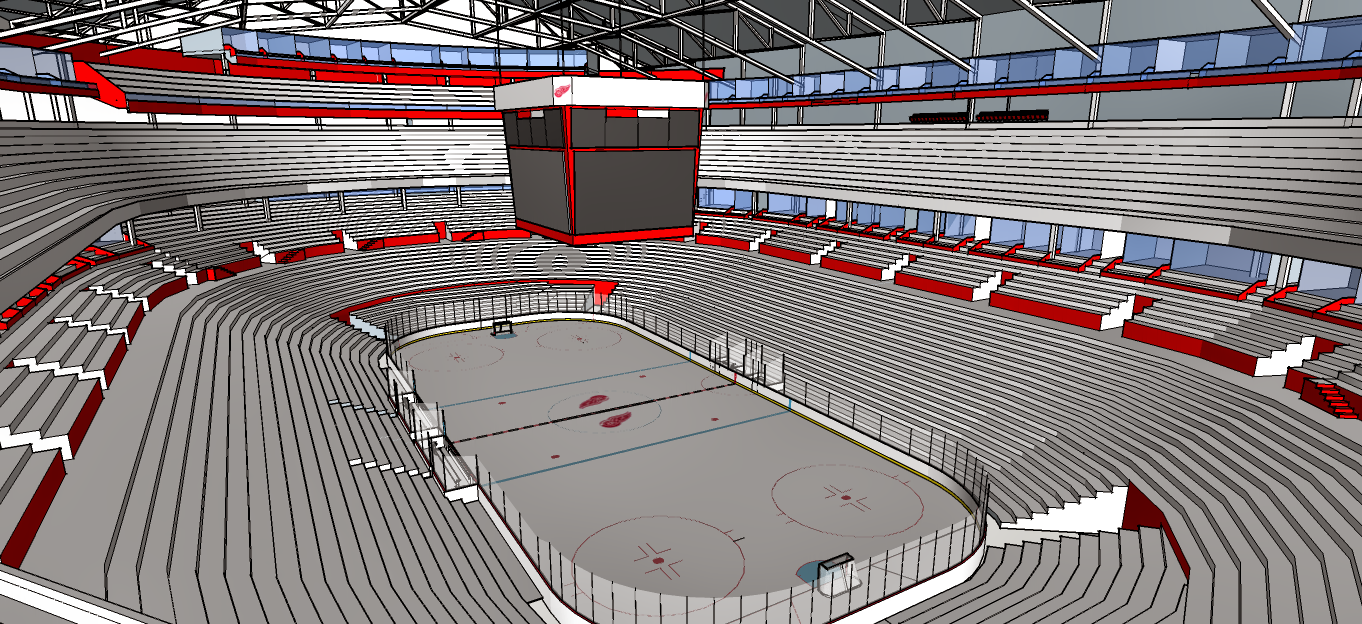
New Olympia Stadium Interior Shots


Welcome to new viewers, I've posted a number of photos of the interior from my prototype of New Olympia Stadium. There is new interest today with the proposed purchase of the Detroit Pistons and possible new arena to follow. Terry Foster wrote an interesting column in the Detroit News about architect Alexander Pollock's concept for a new Red Wings arena with many very nice renderings. You can see them at

While I always enjoy new stadium renderings and his are admittedly much for refined than mine, I'm not a fan of his concept. I don't want to be overly critical of a very creative plan; however, with very little seating on the ends, along with 24 inch wide seats and 48 inch wide rows, I think the back rows of this arena would end up somewhere in Oakland County. My concept has always been about getting as many people as close to the ice as possible, and I hope some of the new renderings reflect that.

New Red Wings Arena Looking up from the opposite blue line

New Red Wings Arena View from upper suites

New Red Wings Arena Rafters and end seating

New Red Wings Arena View from the seats behind the goal

New Red Wings Arena View of lower bowl

New Red Wings Arena View from balcony

New Red Wings Arena View from 3rd level behind the goal

New Red Wings Arena View from the corner

New Red Wings Arena Looking up from the corner

New Red Wings Arena Lower bowl along the boards


Sidebar Poll

Take a look at the newer sidebar poll and let me know what you think of New Olympia Stadium. It looks like just under half of the voters think the New Olympia Stadium is the best option, which isn't too bad given the four choices (glad to see not many want a move to the Palace). When the poll began, I was disappointed; most voters didn't like the plan. That appears to have turned around. The poll may be skewed a bit because people coming to this site may have pulled up Olympia Stadium on a Google search and checked this site out. However, the feedback I get usually runs one of two ways: "wow, I love this plan, I hope they build this", or "I don't think we should rehash history, we need a new, modern arena".

Building a new, huge, high tech arena with massive open spaces, glass walls and flashing lights seems like the easy thing to do (O.K. not actually easy. Rounding up $300-400 million in funding in this economic climate can't be easy). Building a New Olympia Stadium would be somewhat risky. Many people wouldn't like it. Good architecture is inherently risky however. The new Soldier Field was very risky and people didn't like it at all, at first. Today, New Soldier Field is recognized as the most distinctive and successful of the new NFL stadiums. I'll admit, the exterior is incoherent, but with stadiums and arenas, I feel it's what's inside that counts. Attitudes toward New Soldier Field have changed; it is now considered the best, most intimate atmosphere in the NFL and an architectural triumph.

Any sense of intimacy has been lost in among NHL arenas built in the past 20 years. Like Soldier Field, the New Olympia Plan is compact, bringing fans closer to the game and enhancing the excitement of hockey. Isn't that why the fans come in the first place? I hope that the Red Wings organization thinks about not only the team's history of Olympia Stadium, but the success story of New Soldier Field this when the new arena is built in Detroit.

Do e-mail your comments to me at schulzte@gmail.com

New Olympia Stadium - In 3-D

New Red Wings Arena Main Enterance

New Red Wings Arena Overhead with roof removed

New Red Wings Arena Overhead seating bowl


New Red Wings Arena North-South Cross Section

New Red Wings Arena East-West Cross Section

New Red Wings Arena Foxtown

New Red Wings Arena Up Close on Elizabeth

New Red Wings Arena Downtown Detroit

New Red Wings Arena Foxtown
New Red Wings Arena
Foxtown
New Red Wings Arena
Woodward Ave Alternative
New Red Wings Arena
North of Downtown on Woodward
New Red Wings ArenaLooking toward downtown

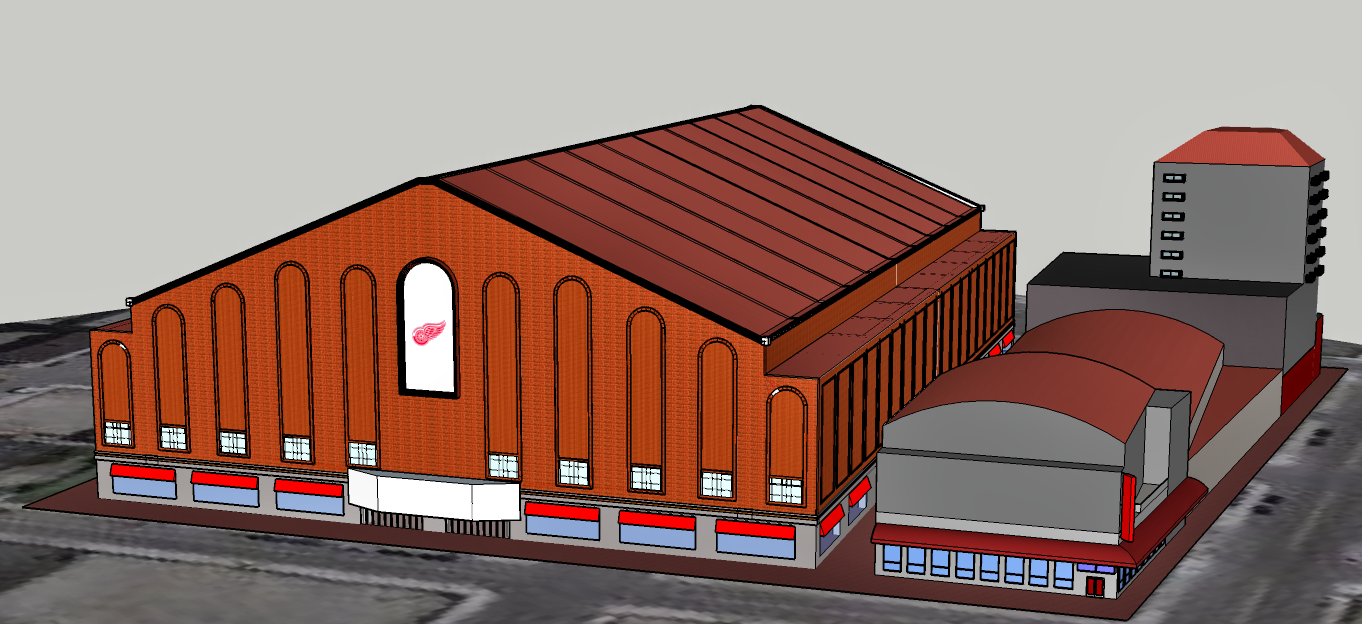
This is a 3-D Model of the New Olympia Stadium. Many of my readers have asked why I don't do 3-D modeling. I always wanted to, but I've never really had the time or the patience to learn it. A couple weeks ago, I downloaded Google Sketchup and watched some of the tutorials. With this week off of work, I finished the model up as well as possible. I don't know how to do the nice brick patterns along the roofline, and I didn't do the interior rooms and seats, etc. However, I did create the seating bowl, roof rafters and supports, as well as the exterior marquise and some of the brickwork.

Again, this isn't professional work, but it is my very first 3-D model, and probably my last for quite some time. I hope you enjoy it.

Woodward Avenue Alternative

New Red Wings Arena

New Red Wings Arena

New Red Wings Arena
These are some models of what the same arena would look like aolong Woodward Avenue two block North of I-75. A reader suggested I see what the arena looks like there. I personally don't think the location is quite as good, but the visuals are really nice going into and leaving downtown. The arena would fit in between Woodward and Park Avenue, so not too many buildings need be knocked down, and only one side street would be taken out.

Basketball Floor Plan

When I first drew up these plans, I didn't conceive that the Pistons were going to be involved in a new downtown Detroit arena. However, with the Ilitch family in negotiation for ownership of the Pistons franchise, I thought it would be appropriate to provide a lower bowl configuration for basketball. The lower end seating would be made adjustable to change their tread, providing more seating toward the floor. Though it would still be a hockey shaped bowl, seating could be pushed closer to the basketball floor. A total of 840 seats would be added to the lower bowl, pushing seating capacity to 20,465 and 21,245 with standing room, just about 800 shy of the Palace of Auburn Hills.

Click the link below to view the FINAL, revised, 21 page plan for New Olympia Stadium. You can download a free PDF version.


http://www.scribd.com/doc/15970672/New-Olympia-Stadium-Plan

Exterior of New Olympia Stadium


These are front and side views for the New Olympia Stadium.

The front facade looks very similar to the original (see below), though it is about 100 feet wider and 33 feet taller. The sides of the exterior look similar, but aren't exactly the same. The new arena is about 40 feet longer than the old arena after the addition. There is actually a second small roof over the concourse portion of the new arena which is hard to illustrate in two dimensions, so it isn't one flat wall from sidewalk to main roof as was the case with the old Olympia. This is why the neon Olympia signage is moved from the side of the building to a separate sign attached to it. The old Olympia had a similar sign when it opened in 1927.


These are front and side views of the original Olympia Stadium. The pictures are courtesy of the Yahoo 1927 Olympia Stadium group, which has great pictures of the old arena.

New Olympia Stadium Site Plan


This illustration better depicts my ideas for the New Olympia Stadium site. Included are the streets surrounding the arena site, and uses for the rest of the plot, including a possible commercial annex and VIP parking and entrance on the western portion of the site. Semi truck loading dock access would come from Park Ave. on the East side of the arena. There would be 90 VIP parking spots and a 1,700 space garage across Elizabeth Street.

Inside Old Olympia

This is Old Olympia Stadium prior to the 1986 demolition. A sad fate for the Old Red Barn, which was in really good shape in 1979 prior to its closing. Courtesy Yahoo Olympia Stadium 1927 Group

New Olympia Stadium-Diagrams

New Red Wings Arena

North-South Cross Section, New Olympia Stadium

This is the North-South Cross Section for New Olympia Stadium. The arena measures 324 feet across. The rafters are constructed exactly like those of the old Olympia, only scaled larger due to the increased size of the arena. This building would be 98 feet wider than the old Olympia, which was 228 feet wide, and about the same width as Joe Louis Arena (328 ft.) Therefore, the height of the arena increases from 107 at the old Olympia to 140 feet at the new Olympia. Notice there are no pole seats along the sides, as they cause more obstructions here than at the ends.


East-West Cross Section, New Olympia Stadium

This is the East-West Cross Section of the New Olympia Stadium. The arena measure 438 feet in length. Old Olympia was 398 ft. in length for comparison. Most current NHL arenas are about 500 ft in length end to end, this would be smaller here due to the compact construction of the seating bowl. Notice the large overhang of the balcony, this will not obstruct ice views other than about 100 pole seats, which are taken out of seating capacity. The poles aren't as obstructive on the ends as along the sides, as the field of view for those seated on the ends is much narrower (85 feet) than those along the sides (200 feet), so the poles don't pose as many problems. The scoreboards will be hung from the end balconies just as the old Olympia. Replay boards will be hung at the Wing-Hi box level. This means no center ice scoreboard is neccessary, just like the old Olympia, though one would probably be used anyway. About 300 seats in the upper portion of the lower bowl (back 3 rows in corners), the Olympia Room and the Executive Lounge will have views of the replay board obstructed by the overhang. Widescreen TV montiors will be hung underneath the balcony to give the same replays to these patron.


Lower Level, New Olympia Stadium
This is the lower/service level for New Olympia Stadium. This level would access the 12 Founders Suites, which would be very large, well appointed suites with access to seating shown in maroon in the lower bowl. There would also be a moderately sized event room at the South end of the suites. The service level along the sides of the rink would be closed to the public and contained player, entertainer, press, and facility management areas. There would also be a truck ramp to access the staging area for concerts and other shows, and three adjoining truck docks for easy loading.


Main Level, New Olympia Stadium

This is the main level for the New Olympia Stadium. This level would access the Lower Arena, Upper Arena and Promenade levels. The main entrance would be on the South end, while the North would also have an entrance, along with a VIP entrance on the East side of the arena. 8 public washrooms and 11 concession stands would be on the main level. Separate stairs would access the Hockeytown Souvenir Store down in the lower level. Corner ramps would move fans up and down the levels, and four elevators would service the disabled. The lower arena level stands would seat 4,247 in 12 rows surrounding the ice, the upper arena level would seat 2,582 in 11-14 rows at each end (see the next page for upper rows). The rear two or three rows may lose sight of the replay boards at the Wing-Hi level. Large HDTV screens hung from under the balcony above each section would provide the same replay views for these patrons. As a result of this overhang, the balcony seating would be about 30 feet closer to the ice surface. The Promenade would consist of 6-10 rows around the rink, seating 1,992.


Olympia Club Level, New Olympia Stadium

This is the Olympia Club level for the new Olympia Stadium. This level provides access to 32 Club Suites, 1,244 club seats along the sides above the lower arena level, as well as the Olympia Room restaurant and Executive Lounge. The Olympia Room would serve up to 200 patrons and the Executive Lounge would serve up to 160 patrons. There would also be 4 concession stands and 8 public restrooms on this level. This level would only be accessed by club and suite ticket holders or patrons of the Restaurant and Lounge. Both the Restaurant and Lounge would have full views of the ice, though there would be some obstructions from support poles.

Obstructed Views at New Olympia


Diagram of obstructed view seating at New Olympia Stadium

The total capacity of the New Olympia Stadium would be about 20,000. Because of the large balcony overhang, some support poles are necessary in the main seating bowl. These would cause some obstructed view for seating in the upper arena section of the lower level. I have highlighted those seats with some ice obstructions in yellow. These would add up to between 100 and 150 seats in total. I don't think this is a huge draw back; as a result of these few obstructions, every seat in the balcony is about 30 feet closer to the ice.


Balcony Level, New Olympia Stadium

This is the balcony level of the New Olympia Stadium. This level would have 12 rows of seating circling the entire rink. This level would have 6,231 seats, and there would also be 750 standing room spaces behind the seating areas. The concourse behind the seating area would be 15-20 feet wide, and contain 6 washrooms and 4 concession stands, one in each corner. This level could be accessed by ramps in the corners or one of four elevators. The balcony seating would overhang most of the upper arena and club seating in the lower bowl, providing outstanding views of the ice. The most distant seat from the ice surface on this level is 124 feet.


Wing-Hi Level

This is the Wing-Hi level that hangs above the balcony all the way around the arena. This level is accessed by corner ramps and elevators. This level includes 26 suites, the press and broadcast boxes, as well as 1,533 seats in six rows at each end of the arena. There would be a private set of restroom facilities and elevators for the North and South Wing-Hi Suites. Team offices and conference rooms are also on this level. Escalators to the second level Penthouse suites would be in the West end.


Penthouse Suites, Mechanical Level and Organ Loft

Ten more suites will be in this top level, accessed from the escalators going to the Wing-Hi level on the West end of the arena. On the East end will be the mechanical level, with scoreboard, audio, and lighting control rooms, as well as the pipe organ loft. Many of the old arenas had a pipe organ loft, and this level would house a large pipe organ installed for live music to be played at intermission and in breaks of play. Ideally, it would rival the organ used at Old Chicago Stadium.


Copyright 2007, T.J. Schulz. All Rights Reserved